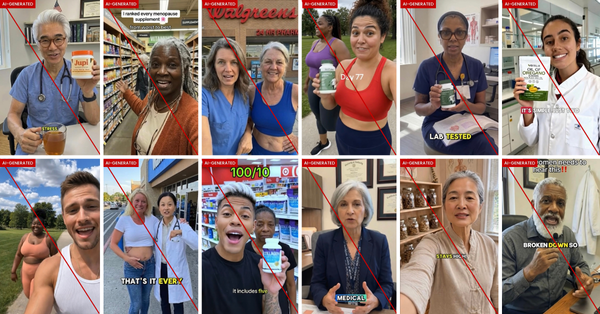
Who Amplified The Lie
Three government officials shared an AI-generated image of a rescued U.S. airman. Then they deleted the evidence.
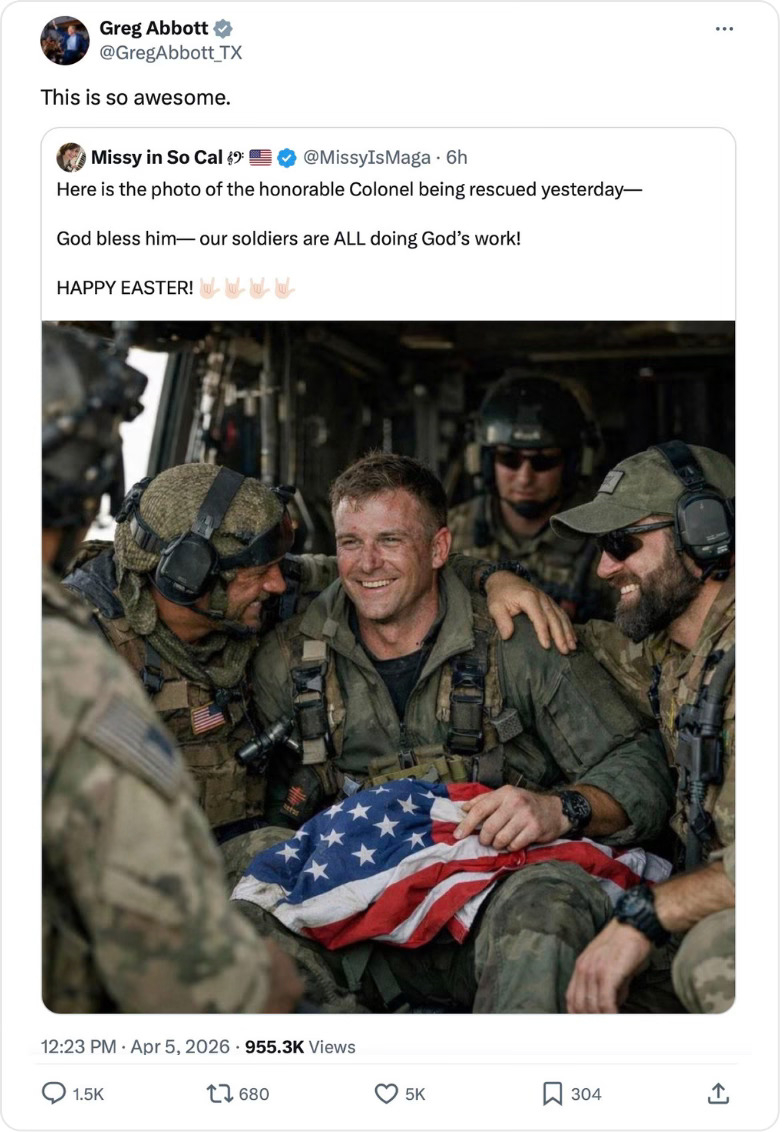
On April 3, 2026, a U.S. military aircraft was shot down over Iran. Two days later, President Donald Trump announced that U.S. special forces had successfully extracted the weapons system operator who had ejected from the downed aircraft. It was the news people had been waiting for. Within hours of that announcement, an image began circulating on social media purporting to show the rescued airman — smiling broadly, an American flag across his lap, surrounded by what appeared to be U.S. special operations forces aboard an aircraft.
It was exactly the image people wanted to see: mission accomplished; a young American servicemember, safe; the good guys winning on Easter morning.
It was fake.
AFP asked both an AI detection tool and a peer-reviewed academic research team to examine the image. Both concluded it was AI-generated.
There was a fabricated visual engineered to look like the moment people had just been told had happened — and it worked, not because it was convincing, but because it arrived at precisely the right emotional moment, when relief and patriotism were already running at full volume.
Here is who amplified it anyway.
Texas Governor Greg Abbott reposted the image to more than a million followers with the caption: “This is so awesome.” (archived here)
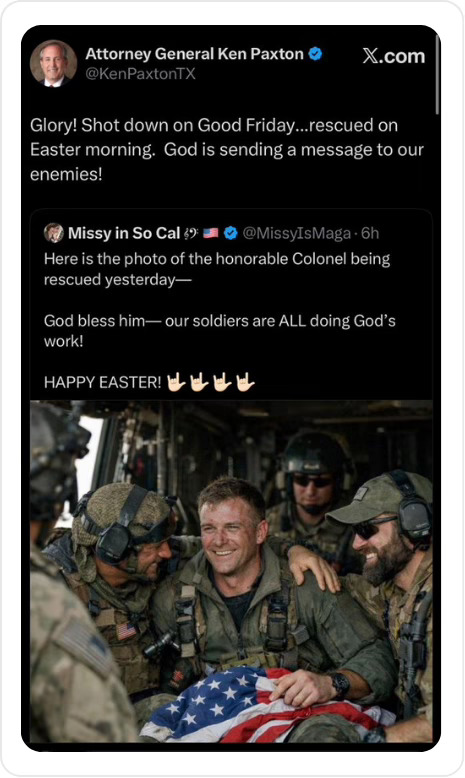
Texas Attorney General Ken Paxton shared it with: “Glory! Shot down on Good Friday...rescued on Easter morning. God is sending a message to our enemies!” (archived here)
Congressman Mike Lawler (R-NY) shared it with: “God Bless America!” (archived here)
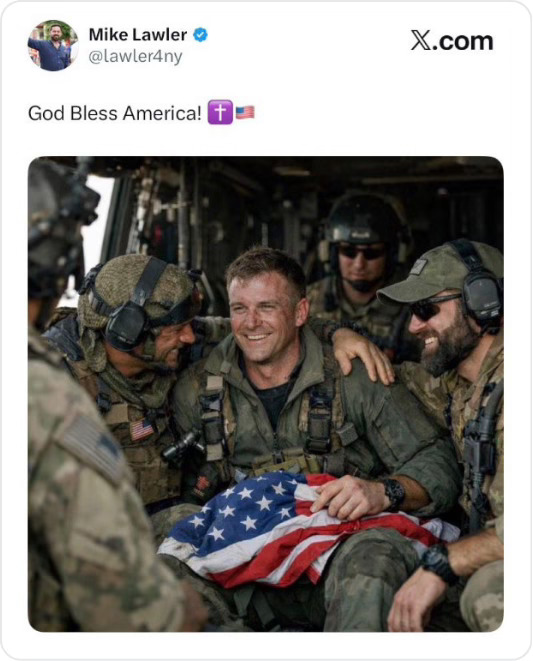
None of these posts carried an AI label or asked whether the image was real. At the time Abbott, Paxton, and Lawler shared it, the image was unlabeled and unverified — and they amplified it to a combined audience in the millions.
These are not anonymous accounts or influencers chasing engagement. These are verified government officials whose followers have every reason to treat what they post as vetted information. When a governor shares an image, the implicit signal to his followers is: I have seen this, I believe it is real, and I am showing it to you. That implicit endorsement is what transforms an unverified image into something that travels with the weight of official credibility behind it — a visual press release, without any of the verification that credibility is supposed to require.
All three posts have since been deleted.
No corrections were issued. No acknowledgments that false information had been shared. No “I got this wrong.” Just — gone.
Deletion without correction means this: the followers who saw the original share almost certainly never saw a retraction. The image had already been absorbed into feeds as credible, laundered through three official government accounts, and by the time the posts disappeared, it had already shaped what a significant number of people believe happened when that airman was found. Deleting a post does not unring that bell. It removes the evidence that the bell was ever rung.
Which brings us to how the image traveled so far before anyone with a platform stopped to ask whether it was real.
Sometimes the spread of a fake image is coordinated. Sometimes it isn’t. What this case demonstrates is that coordination isn’t even necessary because official amplification does the work on its own.
An AI-generated image surfaces at a moment of high public emotion. It tells a story people want to be true. An elected official — scrolling, reacting, and operating on the same emotional frequency as their followers — shares it without verifying it. Their verified account signals to hundreds of thousands of people that this image has been seen and deemed credible by someone in a position to know. Those followers share it further. By the time a fact-check lands, the image has already traveled far beyond the reach of any correction.
Paxton’s caption shows exactly how this works. He didn’t just share the image. He built a sermon around it. Shot down on Good Friday, rescued on Easter morning, God sending a message to his enemies. He had already written the story. The image became his evidence. That is wish-fulfillment operating at full power: a fabricated visual so perfectly timed that it didn’t need to be verified. It needed only to confirm what people already felt was true.
This is not a partisan pattern. The record makes that clear.
In January, Democratic Senator Dick Durbin stood on the Senate floor and displayed what he described as an image from the Alex Pretti shooting in Minneapolis. A Community Note on his X post flagged that the image had been digitally altered — a kneeling officer had no head, and other details had been artificially sharpened from a blurry original.
Earlier this year, the official White House account reposted an AI-generated image purporting to show Venezuelan President Nicolás Maduro in custody.
Abbott, Paxton, and Lawler are the subjects of this piece because they are the most recent documented case and because their combined reach makes this instance particularly consequential. But they are not an anomaly. They are part of a pattern that crosses party lines and reaches the highest levels of official government communication. The common thread is not political affiliation. It is the absence of any verification instinct before hitting share — and the absence of any accountability after.
That absence is something all of us can do something about.
Before sharing any image connected to a breaking news event — especially one involving a military operation, a rescue, or a moment of national crisis — ask three questions:
- Where did this image come from, and who posted it first? Images that surface during high-emotion news cycles are among the most frequently faked. The original source matters.
- Does this image tell a story that seems almost too perfectly constructed? AI-generated fakes are optimized for emotional impact. The rescued airman smiling with a flag on his lap is precisely the image people wanted. That precision is a red flag.
- Has any verified news organization confirmed this image is real? If AP, AFP, or Reuters hasn’t touched it, that absence matters.
These questions are the difference between amplifying a lie and catching one. Elected officials with millions of followers are not exempt from asking them. Neither are the rest of us.
A different image will surface during the next military operation, the next hostage situation, or the next moment of national anxiety. It will be optimized for the emotional frequency of that specific moment. It will arrive in the feeds of governors, attorneys general, and members of Congress looking exactly like the news people are hoping for.
The question Abbott, Paxton, and Lawler never asked — is this real? — is the only thing standing between a fabricated image and the official credibility that makes it travel. They didn’t ask it. They deleted the evidence and moved on.
Don’t let them off that easily. Ask the question yourself. Demand that they do too.
Safe Online Futures publishes regularly on how AI and platform incentives are reshaping the information landscape. Subscribe for free.