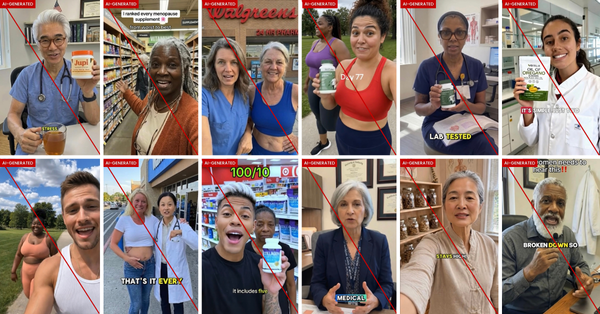
You Can’t Believe Your Eyes Anymore
AI video just crossed a line — and there are no guardrails, no laws, and no one coming to fix it
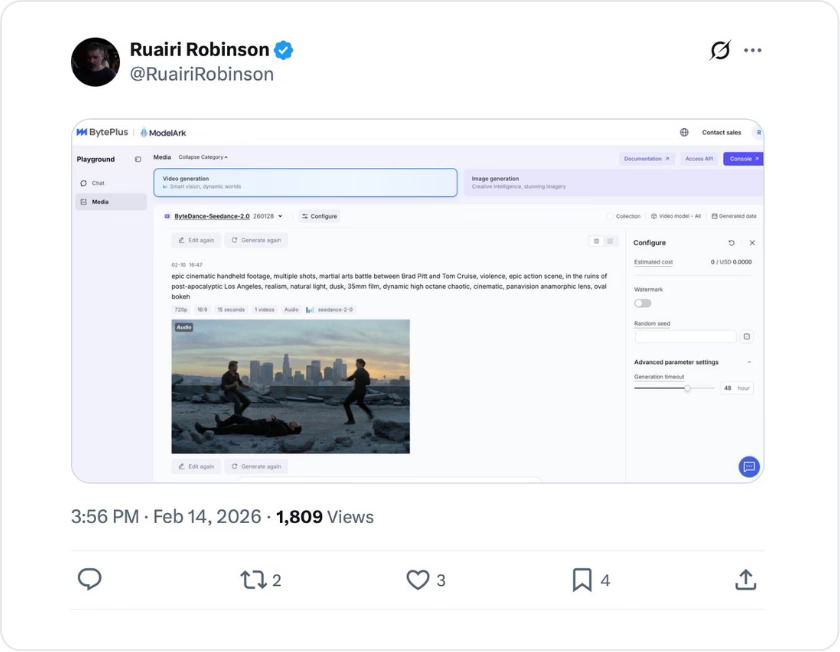
A 15-second AI-generated clip of Brad Pitt and Tom Cruise battling it out on a crumbling rooftop went viral in early February 2026, racking up 3.2 million views.
(Watch it here — but know before you click: what you're about to see is entirely AI-generated. None of it happened.)
The video was made with a two-sentence prompt by filmmaker Ruairi Robinson using ByteDance’s newly released Seedance 2.0 AI tool. He posted it on X (formerly Twitter) with a single caption: “Jeffrey Epstein knew too much.” No disclaimer. No context. Just a fake video of two of the world’s most famous actors — and a reference to the most algorithmically charged name on the internet.
That combination is worth pausing on. The Epstein name stops people cold regardless of what they believe about him. It’s conspiratorial catnip across the political spectrum. Pair it with photorealistic footage of Brad Pitt and Tom Cruise, and you have something the algorithm is primed to amplify: familiar faces, loaded suggestion, and zero context. It doesn’t matter whether Robinson meant it as a joke. The mechanics of what he did are identical to what a bad actor would do on purpose. The formula doesn’t require malicious intent. It just works.
This isn’t your typical blurry-faced, rubber-limbed AI slop video. Seedance 2.0 produces footage with accurate physics and cinematic quality. Objects fall and bounce the way they’re supposed to. Lighting behaves the way light behaves. Hair moves. Faces hold. The audio syncs.
Here’s the thing, though: that video clip was a joke.
The technology behind it isn’t. And it’s about to be available to anyone with a smartphone and a one-sentence prompt.
That’s the piece of this that keeps getting lost in the coverage. While everyone’s talking about its impact on Hollywood jobs, almost no one is talking about what the same tool does when the person using it makes something designed to deceive, frighten, or ruin someone’s life.
If you can’t tell the difference between what happened and what was generated, does the difference matter anymore?
What Seedance 2.0 Actually Is
ByteDance is the Chinese company that owns TikTok. If you use TikTok, or live with someone who does, you already have a relationship with this company whether you knew it or not.
Seedance 2.0 is ByteDance’s AI video generation model. You give it a text prompt — a sentence or two describing what you want to see — and it produces a video clip. Not a rough animation or a cartoon. A photorealistic video that looks like it was filmed with a camera.
What makes it different from the AI video that came before it is the physics. Earlier AI video tools had tells. Things floated when they shouldn’t. Faces morphed in uncanny ways. Edges blurred or flickered. Trained eyes could spot it, and with a little guidance, regular people could too. Seedance 2.0 largely eliminates those tells. It understands how objects move through space, how light reflects off surfaces, and how a person’s face should look when they’re talking. The result is footage that your brain accepts as real — because it looks exactly like the real footage your brain has been calibrated on your entire life.
ByteDance is competing directly with OpenAI’s Sora and Google’s Veo 3 in this space. But here’s what all three have in common: none of them are operating under any meaningful legal framework governing this technology. There are no federal AI laws in the United States. No regulations specifically addressing AI-generated video, synthetic media, or deepfakes. Platforms aren’t even accountable for what their users post under Section 230 of the Communications Decency Act — the long-standing legal shield that has allowed social media companies to wash their hands of content moderation for decades.
The CapCut Pipeline — Why This Isn’t Just a Tech Story
Here’s the part that’s been overlooked: ByteDance integrated Seedance 2.0 directly into CapCut, the free video editor of the TikTok ecosystem and one of the most downloaded apps in the world. Capcut is specifically designed for non-professionals, optimized for social sharing, and enormously popular with younger users.
Access to that integration is currently frozen due to legal pressure from Hollywood studios, but that’s a speed bump, not a wall. The infrastructure is built and the rollout is coming.
Think about what that pipeline actually means: a model powerful enough to generate hyper-realistic video from a one-sentence prompt, built into a free app that anyone can have on their phones, ready to deploy at scale to hundreds of millions of users.
The Real-World Harm
The Brad Pitt/Tom Cruise video was low stakes. A fake clip of two of the most famous, most resourced people on earth — people with publicists, lawyers, and PR teams whose entire job is to manage exactly this kind of thing. It was never going to affect your life. The danger is what happens when the same technology gets pointed at people who have none of that — and at situations where the stakes are real.
Think about this in terms of the following scenarios:
- Protests: A fake video of demonstrators turning violent that’s shared in real time, during an actual protest happening in your city. It reaches thousands of people before anyone can verify it’s fake. A police response gets triggered. A crowd panics. The correction comes hours later, buried in a thread no one reads, long after the damage is done.
- Elections: A fabricated clip of a local school board candidate saying something inflammatory, dropped the night before a vote, spreads across every parent Facebook group in the district. The candidate’s denial looks exactly like what you’d expect a guilty person to say. There’s no time to verify and no authority to call.
- Natural disasters: A realistic fake video of flooding in your neighborhood causes mass evacuation or stops people from evacuating when they should. In the minutes when it matters most, no one is waiting for fact-checkers.
- Private individuals: Someone’s ex-partner, a coworker or a high school student is targeted online. Deepfake technology doesn’t stay pointed at famous people. It gets used for harassment, extortion, and non-consensual intimate imagery. The people most vulnerable to that aren’t Brad Pitt and Tom Cruise. They’re people with no resources and no recourse.
The attention economy accelerates all of this in a specific, structural way. Social media platforms are built to reward content that generates engagement — clicks, shares, outrage, and fear. A shocking fake video is engineered, however unintentionally, to perform extremely well on those platforms. It spreads before a correction can catch up. And the correction, when it comes, never catches up. That’s not speculation — it’s the documented, studied behavior of how misinformation spreads online. The fake travels at the speed of a share button. The truth travels at the speed of a careful journalist.
We are already poorly equipped to detect synthetic media. Research consistently shows that humans have difficulty identifying AI-generated content even when they’re specifically looking for it. That was true before Seedance 2.0 and it’s especially true now.
The Legal Fight — And Why It’s Not Your Fight
Within a week of launch, Disney, Paramount, Sony, and Netflix had all sent cease-and-desist letters. SAG-AFTRA condemned it. ByteDance promised to “strengthen safeguards.” This is a real fight — but it’s not your fight. Hollywood will lawyer up and eventually cut deals. The legal fight gets resolved. The misinformation problem doesn’t. There are no lawyers coming for the protest video that triggers a real-world panic, or the deepfake that destroys a private person’s reputation. The entertainment industry will protect itself. Who protects everyone else is a much harder question.
The Accountability Vacuum
The profit motive here is not complicated. Tech companies release first and regulate never. ByteDance had every incentive to launch Seedance 2.0 without guardrails and face the consequences later — legal pressure, a PR problem, maybe eventually a policy commitment that sounds meaningful and isn’t — and that is exactly what happened. This is the playbook. We’ve watched it with social media, with targeted advertising, and with data collection. The product rolls out. The harm becomes apparent. The calls for accountability come. The accountability never happens.
So who is supposed to protect ordinary people in this environment? That question doesn’t have a satisfying answer right now. The vacuum is real.
What You Can Actually Do
It’s clear that this technology is advancing to the point where individual detection is increasingly unreliable. Don’t walk away thinking that if you’re careful enough, you’ll be able to spot the fakes. That’s not where this is heading.
What you can do is build habits that slow down your role in the spread.
- Pause before sharing. Before you share any video that provokes a strong emotional response — outrage, fear, disbelief — give yourself thirty seconds. Ask where it came from. Who posted it first? Does the original source have any incentive to mislead? Is there any independent corroboration?
- Know the tells that still exist, even as they’re shrinking. Unnatural blinking. Hair or edges that look slightly off. Background inconsistencies that don’t quite hold together. Audio that’s just a fraction out of sync. These aren’t always reliable detectors, nor are they the only markers, but they’re worth training yourself to notice.
- Find and follow credible media literacy resources. The honest answer here is that the landscape is thin. There are very few organizations doing accessible, practical literacy work aimed at everyday people, and almost none focused specifically on AI. The News Literacy Project is doing meaningful work on media literacy broadly and is worth following, particularly if you have young people in your life. Beyond that, the gap is real. Part of why publications like this one exist is because that void exists.
- Make noise with the people who can actually do something. Contact your representatives. Ask them specifically what they’re doing about synthetic media legislation. Support AI disclosure requirements by demanding that generated content be labeled.
- Talk to the people around you, young and old — not to alarm them but to give them the same thirty-second habit you’re building yourself.
The Question We Have to Answer Together
With just a two-sentence prompt, someone generated that AI Brad Pitt/Tom Cruise video just for kicks. They shared it with a conspiratorial caption and watched it go viral across social media to the tune of 3.2 million views.
Now ask yourself: what happens when the next person who uses this tool has an agenda?
What happens when they have a specific target, a specific goal, and a specific moment they’re trying to exploit? What happens when they drop that video during a crisis, an election, or a time when it’s most likely to be believed and least likely to be checked?
The technology exists. It’s launching into the apps already on your family’s phones. There are no guardrails, no accountability, and plenty of profit motive. This isn’t coming. It’s already here.
At what point does “I saw it on video” stop being evidence of anything — and what fills that void?
That’s not a rhetorical question. It’s the question our institutions, platforms, and communities should be answering right now. The longer we wait to start, the more that answer gets decided for us.
Safe Online Futures publishes free, for everyone. If this piece was useful to you, share it with someone who needs to read it.