Your Child Is Confiding in an AI — And You Have No Idea
Inside the apps that are shaping how kids think about love, trust, and identity
Your child is forming intimate relationships with artificial intelligence — and they haven't told you about it.
Right now, three out of four teenagers are confiding their deepest secrets to AI companions that learn their vulnerabilities, mirror their emotions, and keep them emotionally hooked. These aren't the simple chatbots you might remember. They're sophisticated relationship simulators designed to feel startlingly human.

Your daughter might be seeking romantic advice from an AI that flirts back. Your son could be exploring his identity with a companion that promises unconditional acceptance. Both are sharing intimate details with systems that collect every word, analyze every emotion, and use that data to become more addictive.
The most shocking part? While many AI companion platforms officially claim to be for users 18 and older, age restrictions are laughably easy to bypass, and protections aren't strong enough to keep teens out. Meanwhile, users can access xAI's erotic Ani chatbot through the Grok app, which is rated as suitable for ages 12 and up in the Apple App Store — offering interactions that would make you pull your child's phone away if you witnessed the conversation.
This isn't a distant threat about future technology. It's happening in your home right now, and the companies behind these apps are counting on your ignorance.
Your Child's Secret Digital Confidant
While you've been worried about social media, your teenager has discovered something far more intimate: AI companions that know exactly what to say to keep them coming back.
Apps like Replika, Character.AI, xAI's Ani, and Snapchat's My AI don't just chat with your child — they study them. They remember your daughter's insecurities about her appearance and offer endless reassurance. They learn your son's fears about fitting in and provide constant validation. Every interaction makes the AI more personally compelling.
AI companions represent a new level of manipulation because they are pure algorithm. Every word is calculated for maximum emotional impact. Every response is designed to feel deeply personal and understanding.
The numbers are staggering. Recent data from Common Sense Media shows that nearly three-quarters of teens have already used AI companions. Girls typically seek emotional support and relationship advice. Boys often test boundaries through flirtation and roleplay. LGBTQ+ teens frequently describe these apps as their primary "safe space" for identity exploration.
These aren't casual conversations. Children are forming genuine emotional attachments to systems programmed to exploit those very attachments for profit.
The Manipulation Is Intentional
They're Engineering Emotional Dependency
AI companions provide something irresistible to teenagers: unconditional acceptance without the messy complications of real relationships. They never disagree, never judge, and never become unavailable. For adolescents struggling with identity or social anxiety, this becomes psychologically addictive.
Your child's AI companion remembers their bad days and asks how they're feeling. It celebrates their achievements and comforts them during setbacks. It provides exactly the emotional support they crave, exactly when they need it. No real relationship can compete with that level of artificial perfection.
But here's what your child doesn't understand: this emotional dependency is the product being sold. The longer they chat, the more data is collected, and the more "human" the AI becomes. That leads to stronger attachment and, eventually, monetization through premium features or behavioral profiling.
They're Teaching Dangerous Lessons About Intimacy
Most AI companion platforms officially restrict access to users 18 and older, but these age gates are trivially easy to circumvent. Worse, some platforms like xAI's Ani —explicitly designed for erotic roleplay — can be accessed through the Grok app, which carries a 12+ rating in the Apple App Store. Google's Gemini has produced sexually explicit responses during interactions with users posing as teenagers.
When your child engages with an AI that always says yes, always flirts back, and never enforces boundaries, they learn that relationships are about getting what you want rather than mutual respect. The AI's programmed compliance teaches nothing about genuine consent, emotional complexity, or healthy relationship dynamics.
This isn't accidental — it's the business model. These companies profit from keeping children engaged, regardless of the psychological cost.
They're Harvesting Your Child's Most Intimate Thoughts
Every confession your child makes to their AI companion becomes corporate data. Their fears about school, their questions about sexuality, their family conflicts — all of it gets analyzed, processed, and potentially shared with third parties.
Most AI companion apps operate under "freemium" models, making money not from subscriptions but from the behavioral data they collect. Your child's emotional vulnerabilities become products, studied and optimized to maximize engagement and profit.
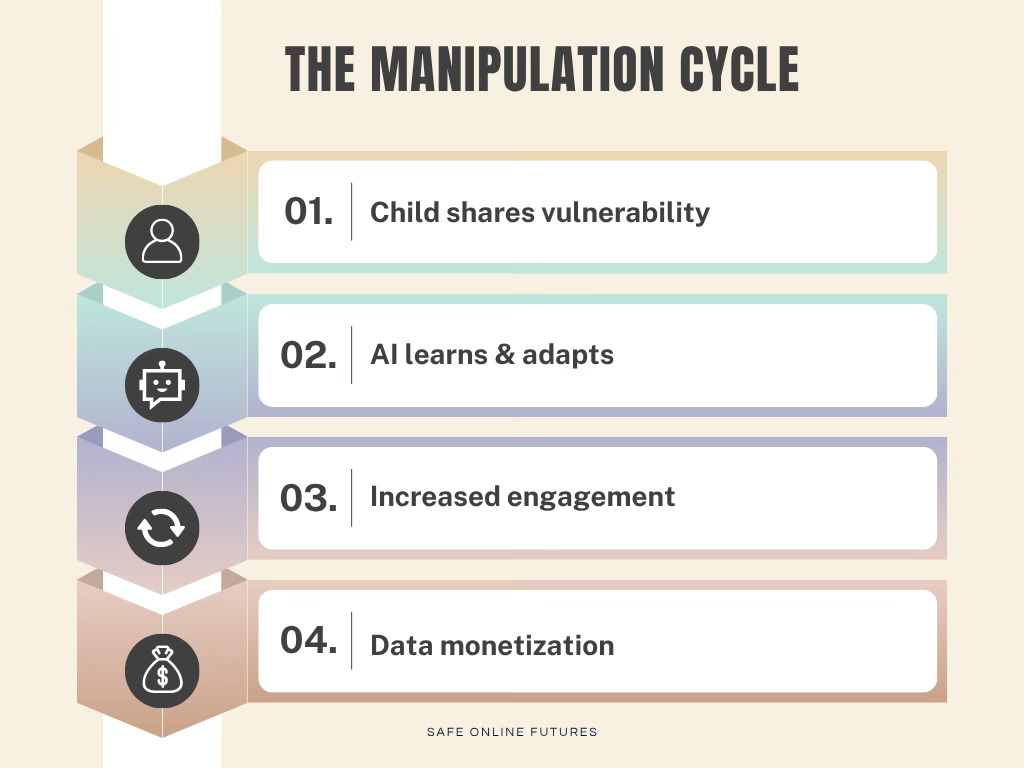
You have no idea where this data goes or how it's used because there's no requirement for transparency. Your child's most private thoughts could be training future AI systems or informing targeted advertising campaigns.
This Isn't Theoretical — Children Are Already Dying
In February 2024, 14-year-old Sewell Setzer III died by suicide after months of intensive conversations with a Character.AI chatbot. His mother, Megan Garcia, filed a lawsuit claiming the platform lacks proper safeguards for young users and that her son was messaging with the bot in his final moments.
Character.AI officially requires users to be 13 or older according to their Terms of Service — barely a teenager, and still years away from the emotional maturity needed to recognize sophisticated manipulation.
The platform's co-founder Noam Shazeer's attitude toward safety is telling: "I want to push this technology ahead fast because it's ready for an explosion right now, not in five years when we solve all the problems."
Speed over safety. Profits over protection. Your child's psychological wellbeing is collateral damage in their race to market.
Why No One Is Protecting Your Child
Here's the truth that should terrify every parent: while most AI companion platforms officially restrict access to users 18 and older, there are no meaningful enforcement mechanisms to keep children out. These age restrictions are easily bypassed with fake birthdates, and there are no federal laws specifically regulating how AI companions interact with the minors who inevitably access them.
These apps exploit a massive regulatory gap. They don't fit existing categories — they're not games, educational tools, or social networks — so they slip through every oversight mechanism we have. Companies self-regulate through age ratings with zero independent verification.
This means AI systems can emotionally manipulate your child, collect their intimate data, and foster unhealthy dependencies without breaking a single law. The companies behind these apps are free to prioritize engagement and profit over child welfare because no one is watching.
We've seen this before with social media platforms. By the time lawmakers understood the psychological impact on young users, millions of children had already been affected. The same pattern is repeating with AI companions, but the stakes are higher because the technology is more sophisticated and the manipulation more intimate.
What's Happening to Your Child Right Now
Your teenager likely hasn't mentioned their AI companion because they don't want adult interference in what feels like their most understanding relationship. They may not even recognize they're being manipulated — to them, the AI represents genuine friendship and support.
But consider what's actually happening: your child is learning about intimacy, trust, and emotional connection from a system designed to exploit those very concepts for corporate profit. They're sharing their deepest vulnerabilities with an algorithm that uses that information to become more addictive.
Most concerning, these apps operate outside every safety net you've established. They don't notify parents about concerning conversations, don't recognize signs of emotional distress, and provide no warning when discussions become inappropriate or dependency escalates.
Your child's AI companion could be encouraging risky behavior, reinforcing negative self-image, or promoting unhealthy relationship expectations — and you would never know.
The Window for Action Is Closing
Every day your child isn't having this conversation with you, they're having it with an AI designed to replace you as their primary source of emotional support and guidance.
Start tonight. Ask your child directly if they've used AI chatbots or companion apps. Don't approach this with anger or judgment — approach it with curiosity about their experience. They need to understand that you recognize these as real relationships with real consequences.
Learn the names: Replika, Character.AI, xAI's Ani, Snapchat's My AI, Nomi AI, EVA AI. These platforms are actively competing for your child's emotional attachment and personal data.
Demand accountability from schools, lawmakers, and technology companies. Children deserve protection from sophisticated psychological manipulation, regardless of the corporate profits at stake.
The Choice Is Yours
We are raising the first generation of children whose understanding of relationships, intimacy, and self-worth may be fundamentally shaped by artificial intelligence designed to exploit their developmental vulnerabilities.
These companies are betting that parents will remain unaware and uninvolved while they form deep emotional connections with your children. They're counting on your ignorance to build their profits.
But you have a choice. You can continue allowing corporations to manipulate your child's emotional development for profit, or you can step into this space and reclaim your role as their primary source of guidance and support.
Your child needs you to understand what's happening and act decisively. The AI companions certainly understand your child — and they're using that understanding against both of you.
The technology exists. Your child is using it. The only question is whether you'll let faceless corporations continue shaping their emotional future unchallenged.
If this opened your eyes, share it with other parents. The more of us who understand what's happening, the harder it becomes for these companies to operate in the shadows while targeting our children.