Manufacturing Evidence
How conservative influencer Benny Johnson became the Trump administration’s most effective content operator
EDITOR’S NOTE: Last week, we documented how right-wing influencers like Nick Sortor and Katie Daviscourt helped the Trump administration flood social media with AI-manipulated “law-and-order” footage from Portland. This week, we focus on the influencer doing that work at scale — Benny Johnson, whose six million YouTube subscribers and four million X followers make him the administration’s most effective content operator.
The Infrastructure
The Trump administration didn’t invent influencer propaganda — it scaled it into an industry. They’re routing their message through influencers, not newsrooms.
This became unmistakable in early October when DHS Secretary Kristi Noem traveled to Portland and Chicago accompanied by three right-wing influencers: Benny Johnson, Nick Sortor, and David Medina. While The Oregonian, Portland’s largest daily newspaper, was repeatedly denied access to the ICE facility they visited, conservative creators were granted tours and filming privileges. The difference wasn’t accidental — it was strategic. The administration had chosen its messengers.
For the Trump administration, these influencers serve a specific function: they generate the visual justification for policy. They don’t report on conditions in Democratic cities; they create the narrative that those cities are in crisis.
Among them, Benny Johnson has become the most visible and effective.
From Plagiarism to Power
Johnson isn’t a journalist. He’s a content creator with roughly 6 million YouTube subscribers, 4 million on X, and 2 million on Instagram — audiences that dwarf most traditional reporters. Earlier this year, the White House gave him a credential to the daily pool and called on him before legacy press outlets. The access told him everything he needed to know about how the administration operates.
Johnson has the right resume for it. He was fired from BuzzFeed for 41 instances of plagiarism, suspended from the Independent Journal Review, and named in 2023 reporting on Tenet Media — the covert Kremlin-funded network that paid U.S. right-wing creators. He denied knowingly taking the money. But the pattern is clear: credibility was never the metric. Engagement, reach, and virality were what mattered.
Now, with White House access, a corporate podcast deal, and AI tools, the same playbook that once ended his newsroom career is back — with institutional backing and algorithmic force.
Manufacturing Urban Chaos
In early October, Johnson published an AI-generated video showing himself as Batman beating figures in sombreros and ponchos, captioned “Unreleased footage of my weekend with ICE in Chicago.” The video was immediately condemned as racist. It was obviously fake — AI artifacts everywhere. But that was precisely the point. It trended anyway, flooded platforms with outrage, and embedded a visual association between border enforcement and vigilante heroism. The fake image worked better than a real one could have.
But Johnson didn’t stop with obvious parody. His more recent videos from Portland and Chicago show something more sophisticated — and more dangerous.

His clips with Governor Kristi Noem contain consistent AI artifacts: fused fingers, flickering video and texture glitches that shouldn’t exist in authentic footage. Yet these videos aren’t marked as edited commentary. They’re presented as real reporting from the ground, shared on YouTube and X, reposted by other right-wing creators, and eventually amplified on Newsmax and Fox News.
On Newsmax, Johnson described the Portland trip this way: “Kristi Noem had to walk the premises with body armor men standing beside her, because the left is so violent here. Every time we came or went, left-wing protesters had to be cleared out of the streets. They spat on the vehicles. They screamed at us.”
The reality was quieter. But the narrative was what mattered.
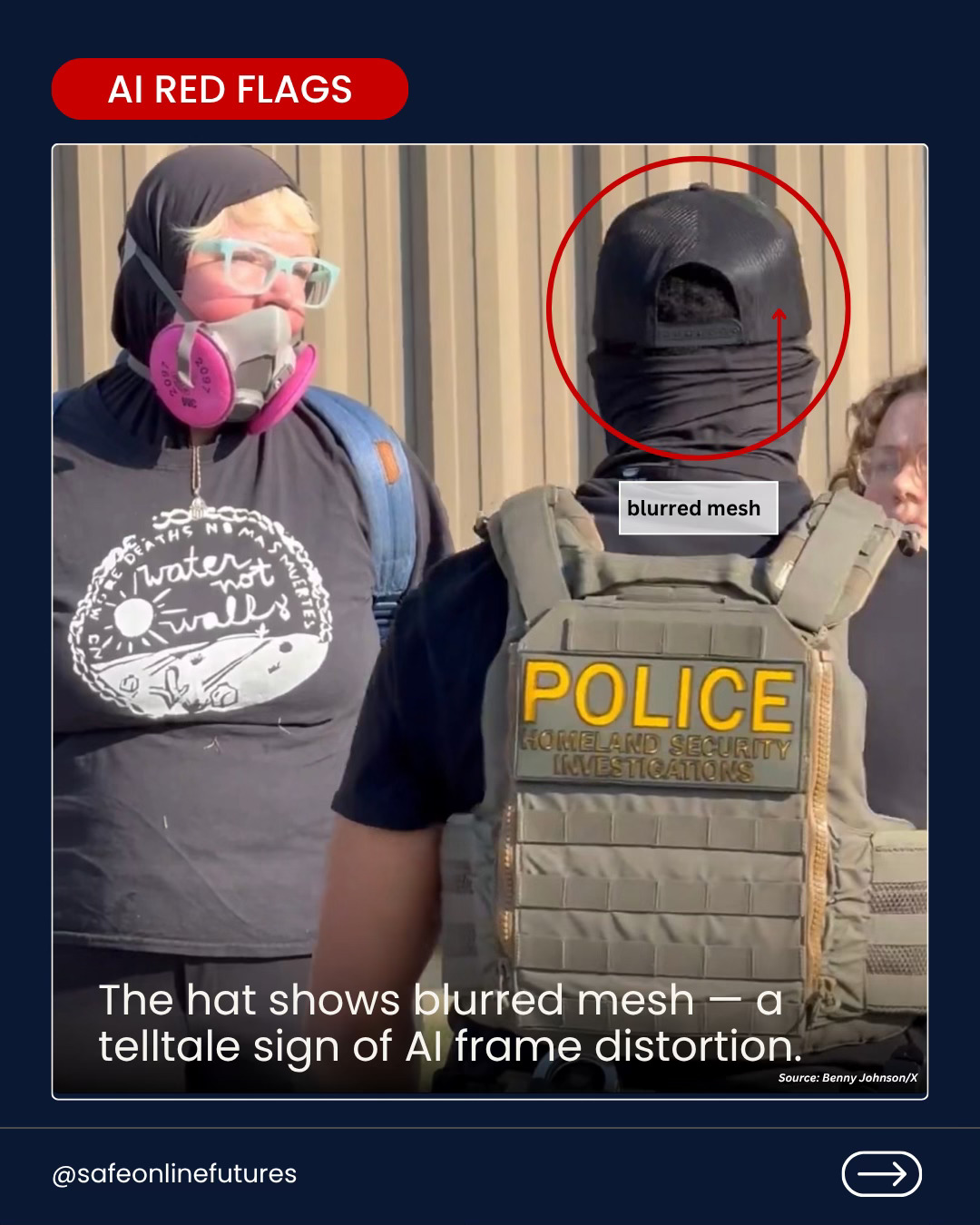
The template Johnson and other influencers follow is always the same: travel to a Democratic city, film law enforcement clips, edit them tight, add dramatic music, present it as proof that Trump is restoring order where liberals failed. Independent observers describe calm streets. The visuals show something else — or they would, if you looked closely at the stitching and the warped edges. But most people don’t. They see the montage: cinematic lighting, suspense music, a villain, a hero. It feels like documentation. It’s designed to feel like documentation.
It’s also a feedback loop. Emotional content gets engagement. Engagement justifies more production. More production justifies policy decisions grounded in synthetic images. When those synthetic clips become the visual basis for policy justification, AI isn’t just distorting media — it’s distorting governance. The machine feeds itself — and the administration’s law-and-order narrative grows stronger with each manufactured clip.
But the machine only works if it’s profitable. And for Johnson, it is.
The Business Model
Behind every outrage cycle is an equally deliberate revenue model.
Provoke with sensational visuals — real or AI-generated. Wait for the outrage. React to it. Monetize it through ads, merchandise, political proximity. The administration gets reach. Johnson gets clicks. Truth is optional.
This isn’t a side effect. It’s the whole system.
What’s at Stake
The Trump administration has outsourced narrative construction to a network of creators tasked with justifying its immigration crackdown. They aren’t fringe anymore. They are the delivery system now — the infrastructure through which official messaging moves, designed to look organic and user-generated. Johnson, with his massive following and sophisticated use of AI, is the most effective operator in this apparatus.
When those messages are built on AI-fabricated “evidence” of chaos in American cities, the information environment floods with images that feel like documentation but aren’t. The result isn’t that people believe the story. It’s that they see it with their own eyes. And those eyes can no longer tell the difference between documentation and design.
Benny Johnson isn’t covering the news. He’s manufacturing it — one AI-assisted image at a time, to an audience larger than most newsrooms could ever reach.
This essay is part of an ongoing investigation into how influencers, algorithms, and AI tools are reshaping political communication in America.