The Illusory Truth Effect
How repetition gets turned into belief
In September 2024, during a presidential debate watched by an estimated 67 million people, Donald Trump claimed that Haitian immigrants in Springfield, Ohio, were abducting and eating their neighbors’ pets. There was no evidence. The city manager had already told reporters there were no credible reports of pets being harmed. The debate moderator corrected him live on air. Trump repeated the outlandish claim anyway.
Within days, a YouGov poll found that 52 percent of Trump voters said the claim was probably or definitely true. A live, on-air fact-check had not stopped it. By then the claim had been made too many times, in too many places, to feel like a rumor anymore. It felt like something people had heard. And things people have heard tend to feel true.
This is the illusory truth effect, and understanding it explains how false claims take hold.
Familiarity Feels Like Truth
When you encounter a claim, your brain assesses one of two ways. It can do the slow work of checking the claim against what it knows. Or it can ask a faster question: does this feel familiar? Have I heard it before? Familiarity is easy to measure and quick to retrieve, so the brain leans on it constantly. The problem is that familiarity is not accuracy. A claim can feel familiar simply because you have heard it many times, regardless of whether it was ever true.
Repetition is what makes a claim familiar. It does not make the claim correct. It only makes the claim easier to call to mind, and the brain quietly treats that ease as a reason to believe. The more often you hear something, the more true it feels, even when nothing about the evidence has changed.
This applies even when you know better. Researchers tested whether existing knowledge protects against the effect. It does not. People rated repeated falsehoods as more true even when they could identify the correct answer when asked directly. The familiar version arrived first and felt right, before what they knew ever caught up.
A Disinformation Technique, Stated Out Loud
No modern politician has used this mechanism more skillfully than Trump, and he has, on occasion, described it plainly. In July 2021, he said, “if you say it enough and keep saying it, they’ll start to believe you.” It is an accurate description of the illusory truth effect. Repeat a claim enough times and it stops sounding like a claim and starts sounding like common knowledge.
The clearest demonstration is the claim, pushed by Trump, echoed by his allies, and embraced by many of his supporters, that the 2020 presidential election was stolen. No court found the evidence to support the claim. Dozens of legal challenges failed. Recounts and audits, including ones run by Republican officials, confirmed the result. The federal agency responsible for election security, then part of Trump’s own administration, called the 2020 vote “the most secure in American history” and stated there was no evidence any voting system had been compromised. The false claim survived all of it, not because new evidence emerged, but because it was repeated relentlessly across rallies, broadcasts, and social feeds until, for a large share of the public, it became the default version of events. Repetition did the work that evidence could not.
The Infrastructure Built to Amplify It
Repetition on the scale required to move a national audience used to be more challenging. It required a microphone, airtime, or a printing press. The modern information system removed that barrier, and it did so in a way that happens to be ideal for weaponizing this effect.
The Springfield claim is a case study in speed, and it did not begin with Trump. It started in a local Springfield Facebook post in late August. By early September it had been picked up on X by conservative figures including Charlie Kirk, whose screenshot drew millions of views. Then it gained the weight of a national campaign: the day before Trump was scheduled to debate Kamala Harris, Senator and vice-presidential nominee JD Vance posted on X that “reports now show that people have had their pets abducted and eaten.” Elon Musk, Ted Cruz, and the official House Judiciary Committee account pushed it further, and by midday Haitians were the top trending topic in the country on X. The next day, Trump echoed the false claim on the presidential debate stage, and by then, most people had already seen or scrolled past versions of it more than once. As I covered in The Attention Economy Explained and How Algorithms Actually Decide What You See, these systems are built to surface emotionally charged content and surface it repeatedly, because that is what holds attention. A claim engineered to provoke does not get shown once. It gets shown again and again, from accounts that look independent of one another, which makes the repetition feel like corroboration.
Days later, Vance said the quiet part out loud. Pressed by CNN’s Dana Bash on whether the claim was true, he replied, “If I have to create stories so that the American media actually pays attention to the suffering of the American people, then that’s what I’m going to do.” Read that again. A sitting senator and vice-presidential nominee, on national television, admitting he would manufacture a story to capture attention. The truth of the claim was never the point. The repetition was.
Memes accelerated the fabricated narrative even further. The Springfield claim did not spread only as text. It spread as cartoons and AI-generated images, including one posted by the official House Judiciary GOP account showing Trump cradling a duck and a kitten that racked up 88 million views on X.

Trump joined in himself, sharing an AI image to Truth Social of his own jet filled with cats and ducks just hours before he repeated the claim on the debate stage.
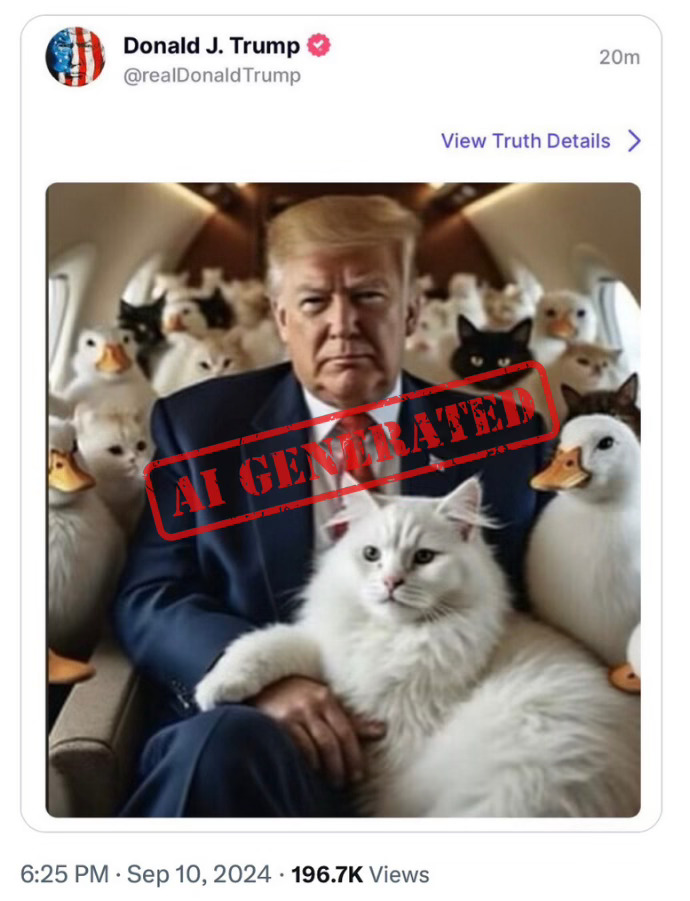
People shared these because they were funny or outrageous, not because they were true. PolitiFact reviewed the images, noting that people engaged with the story they told, not with whether the pictures were real. A meme is repetition in a form people pass along willingly, and each share is another exposure that builds familiarity with the claim underneath it. You do not have to believe a meme to be affected by it. You only have to see it enough times.
Most people do not realize that platforms are not fact-checking the claim before amplifying. They are optimizing for engagement, and a provocative falsehood often produces more engagement than a measured truth. The system rewards the claim with reach, the reach produces repetition, and the repetition produces familiarity that the human brain reads as truth. No coordination is required. The incentives do the work on their own, and anyone who understands the mechanism can use it on purpose.
The result is measurable. The YouGov poll found a majority of Trump voters rating the claim true within days of the debate. A month later, after the claim had been thoroughly debunked by local police, the Republican governor, and national press, a Washington Post poll of Ohio voters still found that 42 percent of Republicans said Trump had told the truth about the pets. That is the illusory truth effect and the platform infrastructure working together: a claim the Republican vice-presidential nominee admitted he would manufacture, believed by a large share of the public weeks after it was disproven, because it had been repeated far more often than it was corrected.
Why This Is Important To Understand
The illusory truth effect is not a sign that people are stupid or that one political side is uniquely gullible. It runs on a mental shortcut that operates in everyone, beneath conscious reasoning, and it works even on people who know the facts. The mechanism has no politics of its own. It is available to anyone, on any side, who wants to make a claim feel true through sheer repetition. That is precisely why it is so useful to anyone trying to push a belief the evidence does not support.
The pets were never in danger. The city said so, the police said so, the governor said so, and the debate moderator said so on live television. None of it competed with the sheer number of times the claim was repeated. Weeks after it was disproven, a large share of the public still believed it, not because the evidence changed, but because the repetition never stopped.
The next piece looks at why we treat a claim as more credible when we believe others already accept it.
This is part of The Blueprint, a foundational series on how the digital information system was built and how it works. Subscribe below to follow the rest of the series.