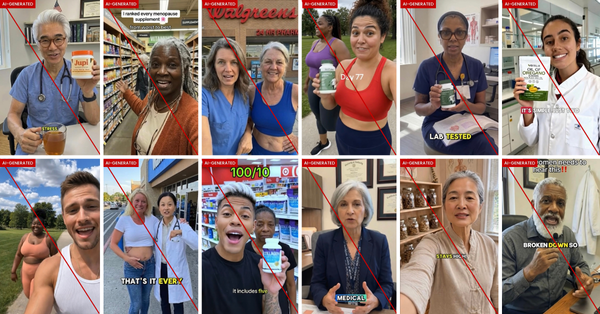
A $125 Shirt Sold Out in Hours. Ask Yourself Why.
Before you move on from the Tiger Woods story, pause here for a moment.
On Friday, March 27, 2026, pro golfer Tiger Woods was arrested on suspicion of DUI near his Jupiter Island, Florida home after his Land Rover reportedly rolled onto its side at high speed. He blew triple zeroes on a breathalyzer but refused a urine test. No alcohol. No drugs found in the vehicle. He was held for eight hours per Florida law and released that night.
By the time his mugshot hit the internet, something else was already happening.
The blue polo he was wearing in that photo — a $125 shirt from his own apparel brand, Sun Day Red — sold out in every size within hours.
Every. Single. Size.
The internet connected the dots faster than any marketing campaign ever could. And that right there is the story I want to talk about today. Not the arrest. Not whether Woods has a substance problem. Not the legal implications. Those conversations are happening everywhere else.
What I want to talk about is the machinery that activated the moment that mugshot dropped. Because if you’re a regular reader here, you already know: that machinery doesn’t care whether a story is true. It just needs the story to be plausible enough for people not to look too closely.
And this one was very, very plausible.
First: Follow the Money
Woods had an immense amount at stake in an extraordinarily narrow window of time. Look at the timeline:
- March 24, 2026 — Woods appears in the TGL Finals, hitting a handful of shots for his Jupiter Links Golf Club team. It’s his most visible on-course appearance in months. Speculation about a Masters comeback immediately spikes.
- March 26, 2026 — Sun Day Red launches Drop 1 of the Spring Traditions Collection — a Masters-themed line featuring Augusta-inspired colors, a reimagined Legend Polo, and limited-edition footwear. Woods promotes it on Instagram: “A legacy unlike any other. The Spring Traditions Collection: Drop 1 is available at the link in bio.”Two more drops are scheduled for March 31 and a date yet to be announced.
- March 27, 2026 — The arrest.
- March 31, 2026 — Sun Day Red Drop 2 of the Spring Traditions Collection drops. Woods pleads not guilty to DUI charges and announces via Instagram he is 'stepping away to seek treatment.' The attention machinery keeps moving.
- April 5, 2026 — Woods was scheduled to appear in Augusta, Georgia to unveil The Loop at The Patch, a nine-hole short course he designed in partnership with Augusta National Golf Club chairman Fred Ridley.
- April 9–12, 2026 — The Masters Tournament. Woods had been publicly undecided about whether he would compete, generating weeks of sustained media speculation.
- End of March 2026 — Woods faced a soft deadline to decide whether to accept the U.S. Ryder Cup captaincy for the 2027 matches in Ireland, one of the most high-profile roles in international golf.
- Ongoing — Woods chairs the PGA Tour’s Future Competition Committee, driving a major restructuring of the tour model targeting the 2027 season, and holds active sponsorship deals with Insperity, TaylorMade, Bridgestone, and Rolex. Sun Day Red is simultaneously expanding internationally, with a permanent flagship store planned in Taiwan.
That is not a slow news week for Tiger Woods. That is a convergence of commercial, institutional, and competitive stakes unlike almost anything else in professional sports right now.
And then, right in the middle of it, a mugshot goes viral. The shirt in that mugshot sells out. Two more collection drops are still coming.
I’m not telling you what to conclude from that. I’m asking you to notice it.
Now, Let’s Talk About the Photos
Two images have circulated widely alongside this story. Both were attributed to official sources. Both contain anomalies that are consistent with documented markers of AI image generation and manipulation. I’ve included the annotated images below so you can evaluate them yourself.
The Mugshot
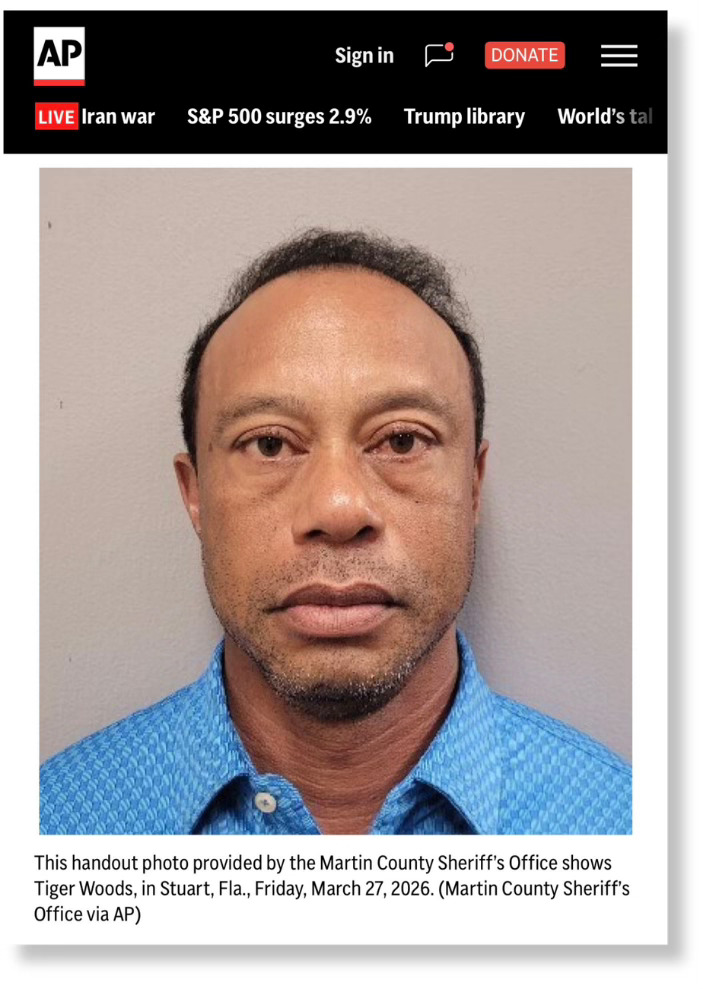
The annotated slide below identifies three areas worth examining closely.
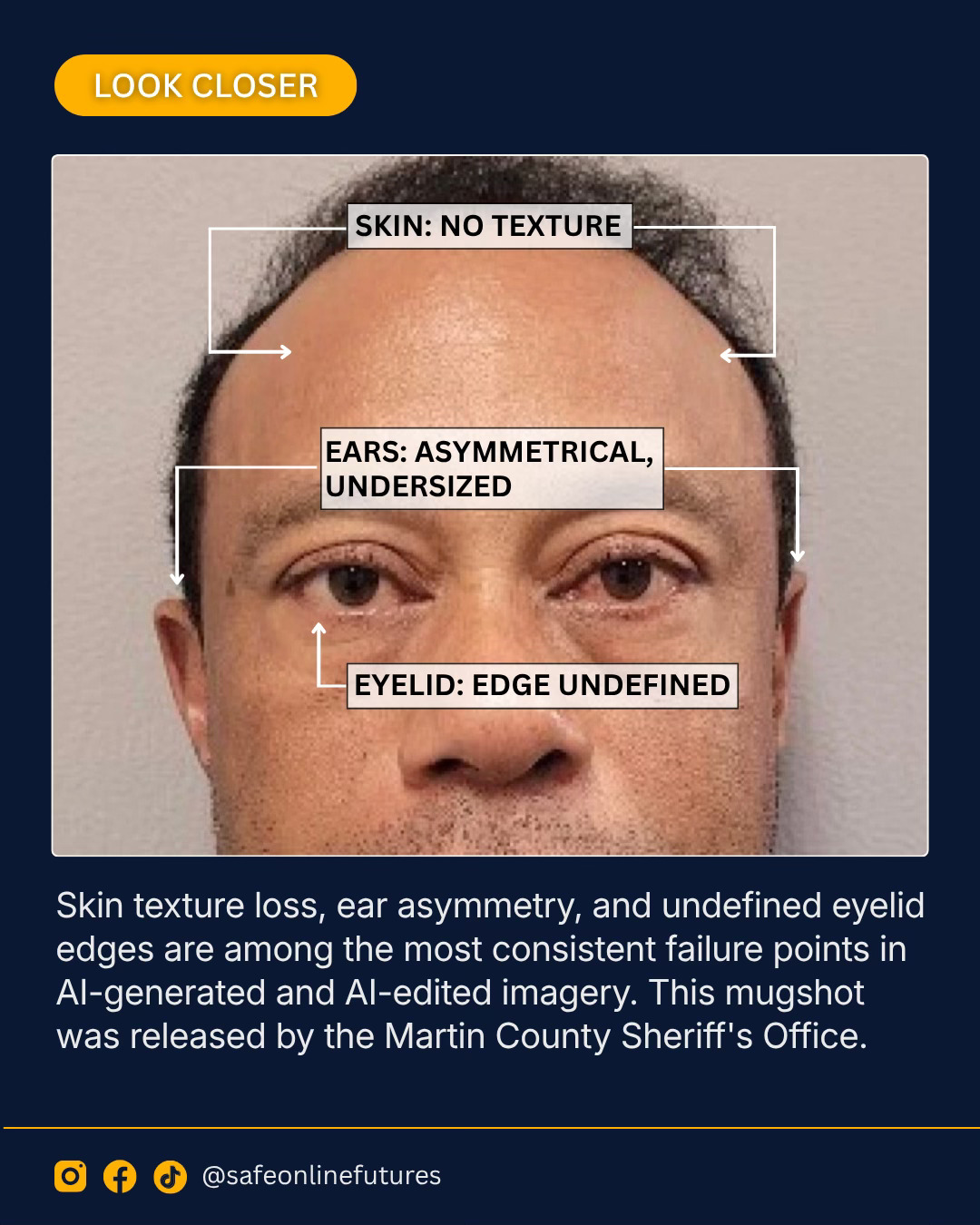
The sides of Woods' forehead appear smooth and textureless in a way that is inconsistent with how human skin renders in photography. Skin has texture. These areas don't. This kind of localized detail loss, where specific zones of a face fail to resolve while surrounding areas appear normal, is a documented artifact of current AI image generation tools.
Now look at his ears. In a straight-on photograph, ears should sit on roughly the same plane and appear roughly the same size. They don’t here. One is noticeably smaller than the other, and both appear smaller than ears visible in other widely published photographs of Woods. Ear rendering is one of the most consistently cited weak points in AI-generated faces.
Finally, look closely at the space beneath his lower right eyelid. The area is blurred with no texture, and the lower lid edge itself is not clearly defined. It bleeds into the white of the eye rather than holding a clean edge. That kind of edge degradation is a known AI artifact, and it’s most visible when you zoom in.
The Crash Scene
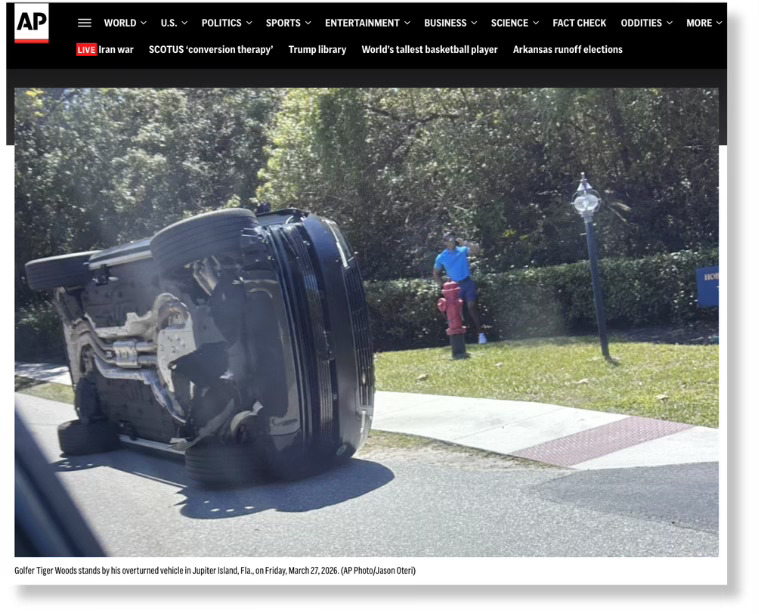
This photo, credited to AP photographer Jason Oteri and widely republished, shows Woods standing near his overturned vehicle while on the phone. The annotated slides below identify the areas worth examining closely.
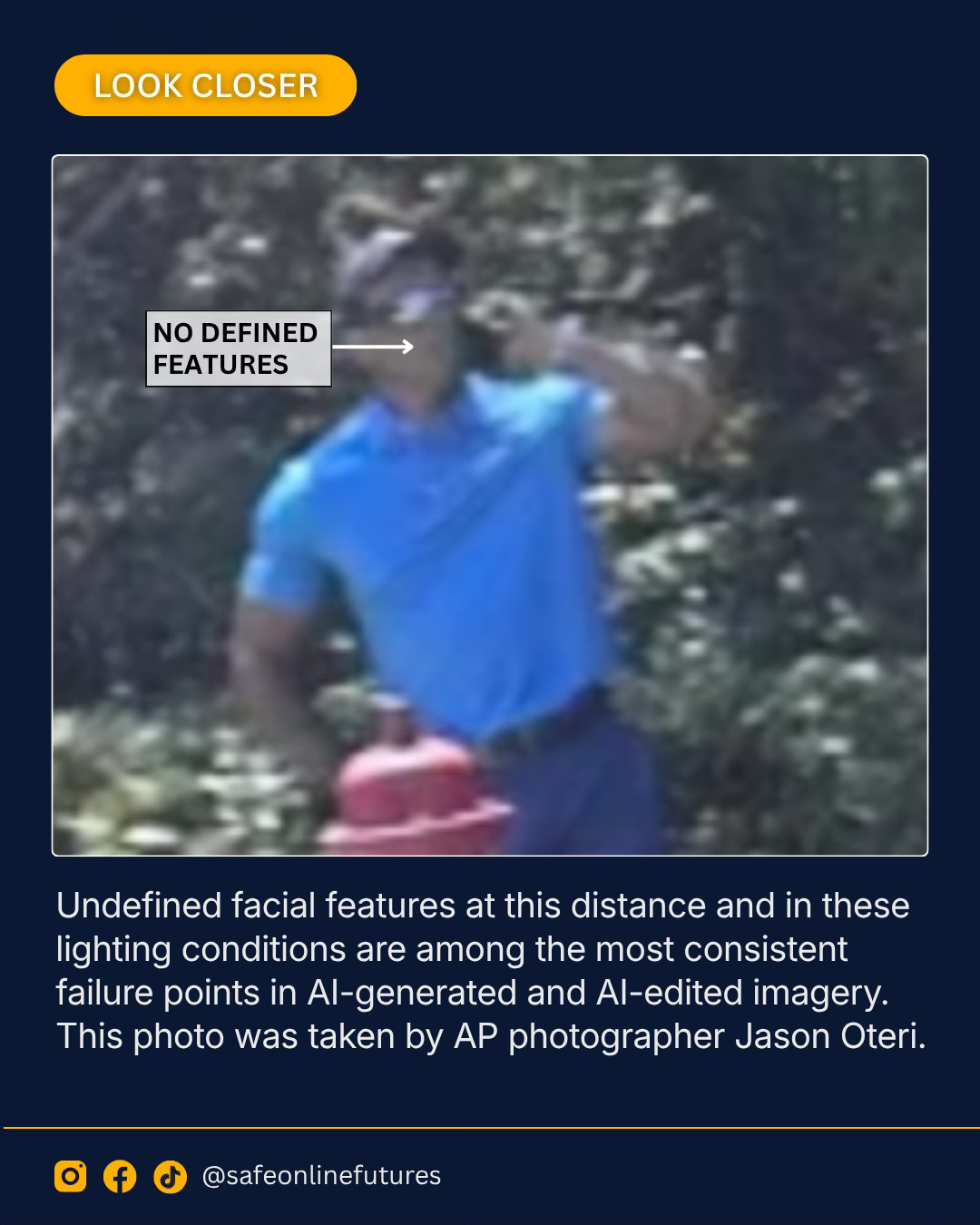
Start with the face. In outdoor daylight conditions, at the distance shown in this photo, you would expect to see a clearly defined nose and mouth on a human face. You don’t. The facial features in this area appear as an undefined smear rather than resolved anatomy. Zoom in and see for yourself.
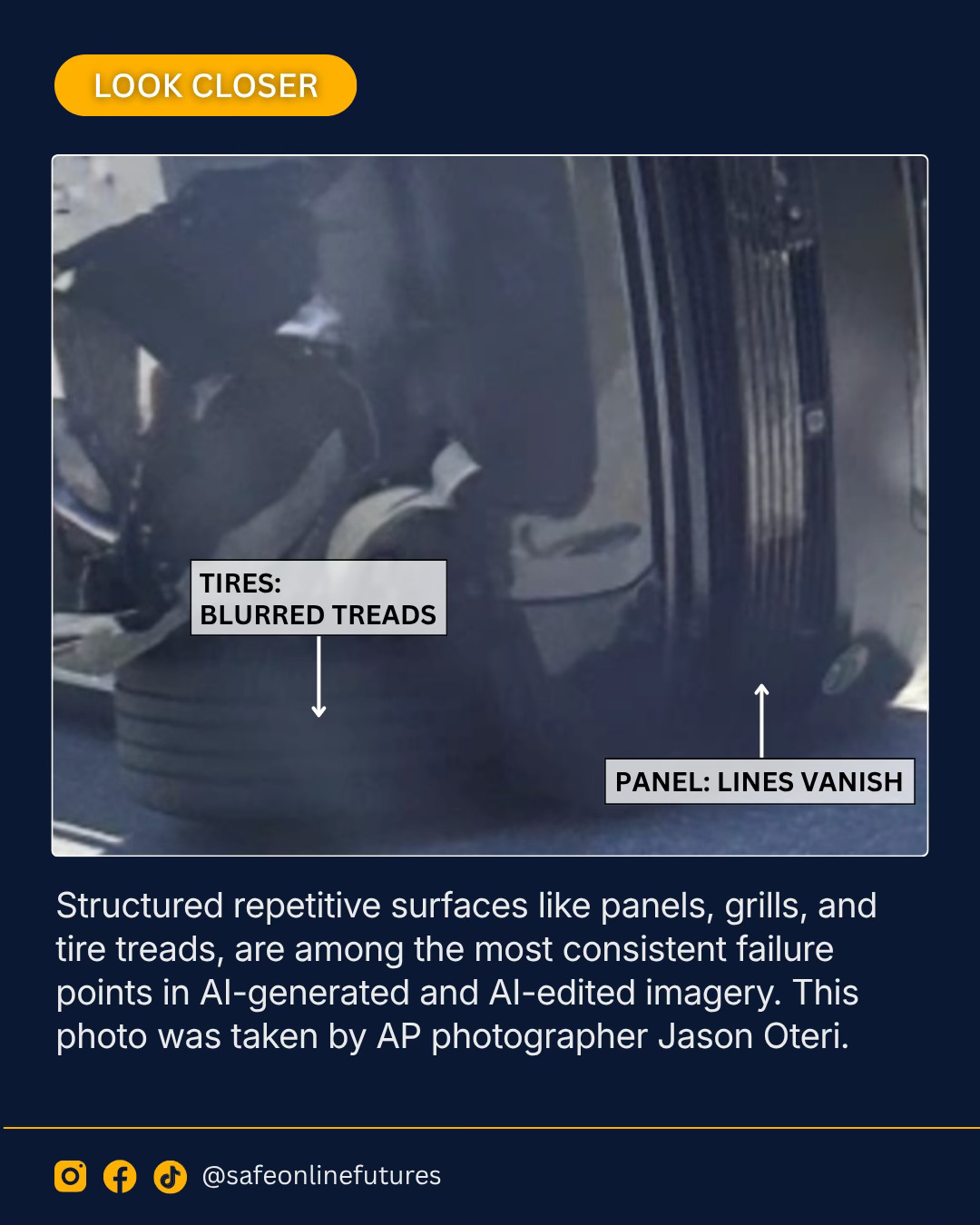
Now look at the front bumper panel and the tire. The panel consists of horizontal lines running down the right side of the frame. Those lines simply vanish rather than fading or darkening the way a surface in shadow would. The tire beside it shows the same problem: where there should be clearly defined tread, the surface blurs out into a detail-less zone. Structured repetitive surfaces like panels and tire treads are among the most well-documented failure points in AI image generation.
Here’s the Framework
So what does all of this actually mean?
We are now living in a media environment where AI tools capable of generating and manipulating photorealistic images and video are publicly available, cheap, and require no technical expertise. There is no federal legal requirement to disclose their use. And the most effective AI-assisted narratives aren’t built on obvious fabrications. They’re built on plausibility. On stories that fit existing patterns so well that most people never think to look any closer.
Woods has a documented history of DUI arrests and car crashes. That history did the credibility work here. When this story broke, most people’s first reaction wasn’t let me scrutinize the accompanying visuals. It was well, this tracks. That’s not a character flaw. That’s exactly how plausibility bias works, and it’s exactly why AI-assisted narratives are so difficult to detect. They don’t have to be true. They just have to be believable. To enough people. Fast enough.
Speed, volume, and plausibility overwhelm scrutiny every single time.
The question I want you to consider isn’t did this happen? I can’t answer that, and neither can you. The question is: who benefits from this story, right now, at this specific moment? When you can map the beneficiaries as clearly as I’ve mapped them above, when the timing is this precise, and when the photos that accompany the story show anomalies worth examining, the responsible thing isn’t to accept the narrative uncritically. It’s to pause. To look closely. To ask the question out loud even when it’s uncomfortable.
That’s not conspiracy thinking. That’s media literacy. And in the world we’re living in now, it might be the most important skill any of us can develop.
If this made you think, share it with someone who needs to read it. And if you’re not already subscribed to Safe Online Futures, this is exactly the kind of analysis I publish — because understanding how these systems work is the first step to not being manipulated by them.